Editor's Guide: when talking about b-end products, we usually take out C-end products for comparison, which can help us see what is the key behind b-end and C-end products, and trigger us to think about what these different keywords represent. The author of this article uses a wealth of cases to analyze the definition of b-end products for us. It is recommended that the little partners who are learning the product end read it and look at it together.

1、 What is the difference between b-end and C-end products?
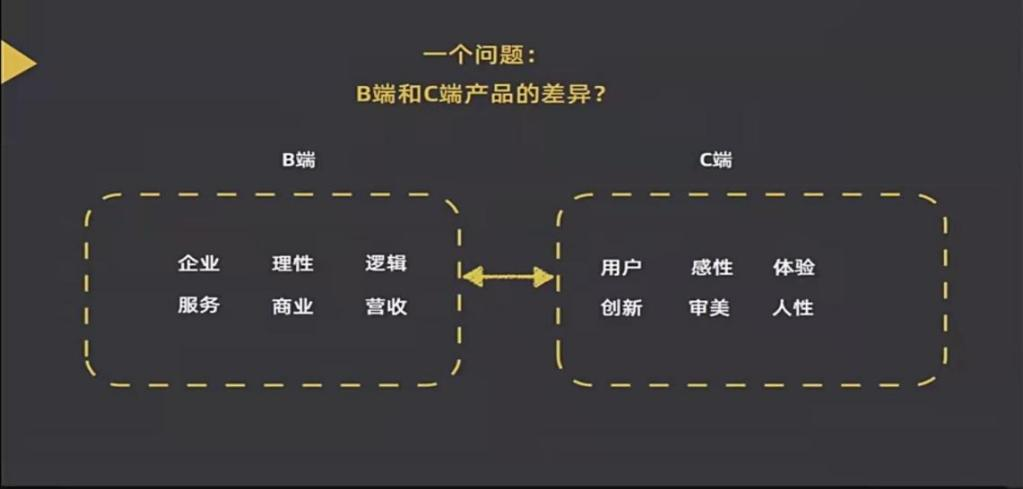
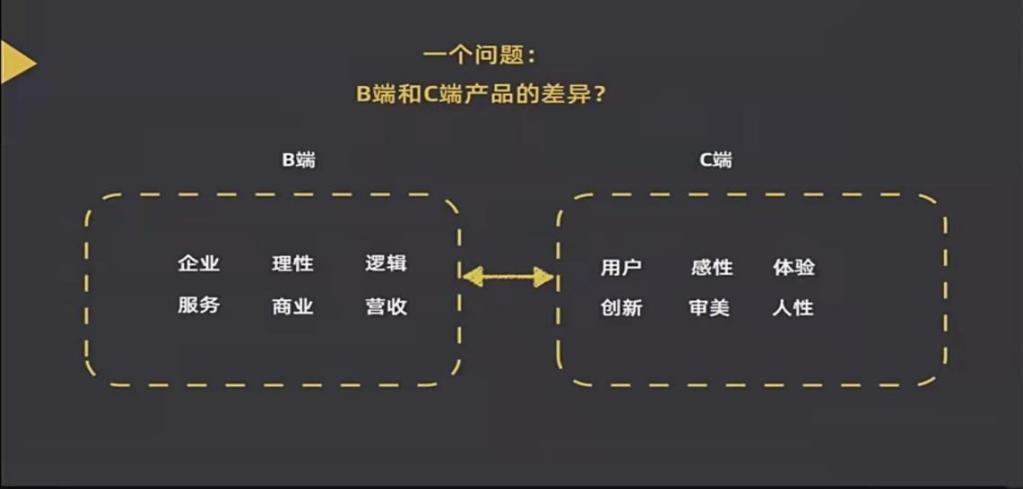
Firstly, the first definition is to analyze what is the b-end product. Before talking about the b-end product, let's take a look at the above figure. When talking about the b-end product, we will generally take out the C-end product for comparison, so that we can clearly see what is the key behind the b-end and C-end products, and trigger us to think about what these different keywords represent.
1. What are we talking about when we are talking about end B
We talk about merchants in enterprises. In fact, all enterprises and merchants are talking about the essence of Commerce. We look at the user groups covered around the essence of Commerce, make rational analysis and logical derivation, and then see how these business models finally achieve this profit goal, and then what our revenue model looks like.
From the perspective of the C-side, the object of our direct service is users. In all user demands, we will see that they are actually individuals, with some consumption, or some needs to be met. In this regard, users are relatively individuals. Individuals themselves are more emotional and have strong experience demands. Then, in order to meet these demands, we will continue to tap human nature. We need to do some innovation or do some beautiful things, and then meet these needs of users.
For the C-end product, you can see it at the first time, because it just corresponds to the demands of each user, and this user is actually an individual consumer many times, so you can directly feel that if it is a C-end product, every individual may be his demand side.
Everyone can give a little advice and say that you are not doing the right thing. It seems that you can't meet the needs of users, so this is why there are many so-called user needs. The threshold of the concept of users is relatively low, because one of the individual consumers may be a potential consumer, He can come and talk about your product.
However, for b-end products, the key core of b-end products is the core of business. Most of the time, we will not see the core of business for the first time. Its service field will be relatively behind the scenes, so we often say that being a b-end product manager is actually a bit like a behind the scenes hero, including the group he serves may also be more commercial individuals, So his threshold is natural.
In this business field, if you represent a role in this business group, you may have more say in this thing, so the range of C-end is wider, but the threshold is relatively low, and the product manager of b-end is not so wide, but the threshold is relatively higher, because there are natural requirements for his own depth, It is required to think and judge some core links behind your whole business before you can make b-end products. This is the difference between the two keywords.
Why is there such a difference? The essence is that the positioning and service scope of the two are different. In fact, we can abstract the difference here. B at the end of B is busines. Business is the concept of an enterprise and a business entity. Its core is to make profits. It will need to use many production factors, such as production and processing of these production factors, So as to produce goods or services, and then according to the sale of these goods or services, finally obtain the result of profit.
B-end user role is actually a legal person or a social economic organization. It itself is a concept of a business entity, not a natural person. We serve an object such as a social organization, legal person, enterprise and company, so this is the core service field of b-end.
The core of the C terminal is actually consumer. Consumer is actually an individual consumer. In order to achieve the purpose of individual consumption, he will spend money or spend time to buy, or obtain such products and services through the so-called free mode on the Internet. Generally, it is actually a personal role, so it is partial to the nature of natural person, This is the core difference between the two.
End B refers to the business organization's goal of making profits, so it naturally takes the business carrier as the main service scope, and end C takes the consumer as the core. Then, the consumer's words usually mean an individual consumer, focusing on how to meet the individual consumption, so as to achieve his consumption demands and consumption purposes, Therefore, its scope lies in the field of how to meet the consumer demand of C-end and how to achieve it. Therefore, this is a core difference between B and C.
After we understand the core differences between end B and end C, we can also see what our common end B products are, such as Alibaba cloud, meicai.com, Qianniu, OA system, ERM system, meituan merchant version, CRM system, nailing, business background management system, BI system, enterprise wechat, Kingdee, UFIDA, Guan Yiyun, CRM for enterprise sales, nailing wisdom education Medical target task management system, second-hand e-commerce internal marketing, small and micro economic loans, enterprise financing business, medium and Taiwan business collaborative processing system, etc. are all b-end products.
2. What is the b-end product
The first is qianniu.com. Qianniu is actually a Taobao system. It is the seller end used by all Taobao sellers. It operates the business ecosystem on Taobao platform and helps sellers to be the operation and management platform for their Taobao business. Therefore, it defines itself as a one-stop business operation platform.
Its core competence is that after the merchant comes in, one part is to manage my business and my data, and then what I want to do now, including some specific situations in the store (including managing my own transactions and my own goods), and the other part is to manage the specific actions of his business through the investment page Taobao express, etc, Then at the same time, there will be some IM communication ability to communicate with buyers, as well as some information related ability to help business growth.
So its core capability is called one-stop full link workbench. In fact, its actual capability is to help it do the operation and management of the whole business. In addition, it is the so-called commercial media portal. Here is how to help it improve its operation capability, capability level and all-round service, I understand that in addition to the operating capabilities of its own platform, it should also win a lot of this open platform, so that some capabilities of ISV can be accessed, so this is his definition.
We can understand that Qianniu is not an independent brand. It is in the system of Taobao. If you, the seller, want to do business on Taobao, how to guide customers to manage and operate their own business in Taobao business, how to manage customers' business process on Taobao platform, and what kind of things users may need us to do, What can we do to regulate and guide users, so this is called Qianniu one-stop business platform.
Let's take another look at sales ease. Sales ease, whether PC or client, has a relatively core ability for enterprises to manage and operate their customers' sales CRM. If it extends, it will also have some abilities, such as marketing ability, customer service ability, project profitability of data analysis or PAAS ability, So he positioned himself as mobile CRM, reshaping the link between enterprises and customers.
Its core is the ability of enterprises to connect customers, but it does not directly help users to say that I can directly pull a field with you, pull customers in and guide customers to you. He did not do this, so his core is the ability you need to do business. I give this ability to you, So I began to find that hey, it seems a little different from Qianniu.
Let's look at youzan, like youzan. It provides SaaS company called business services in various industries. It will focus on some of its own products, including different industries. There will be some business solutions for this industry that can be directly selected, or there will be some solutions for some large customers. At the same time, He will also have some other services, such as for some special scenarios, such as commission distribution, distribution, advertising, etc. there may also be some other customized services or store opening services, so he will find that he likes its positioning.
There is a key word in it, which I think is very important. It is to help every merchant to privatize customer assets. Here, we will also find that it is a little similar to the just sale. The main reason is that it provides a kind of commercial service ability, which is to empower merchants, not to directly help merchants do drainage, but to help merchants do business, It is mainly to help merchants how to manage all their private customers and how to expand their business. Therefore, what they are doing is actually the management of private domain, which is commendable.
Let's look at nailing. Nailing's own positioning is not called me to help you do business, but it cuts into another perspective - mobile office and collaborative office, starting with the demands of enterprise management. The enterprise management appeal is based on the management meeting of the whole organization management collaborative office as the starting point to help many large, medium and small enterprises access the digital working mode, so it seems to be cut in from another dimension.
Especially during the epidemic period, some changes have taken place in the way we work based on enterprises, which makes it relatively more feasible to work at home. If there is no wechat and no nails, we may not be able to do many so-called office at home software today, do a lot of collaborative linkage, and then do online approval and communication, Therefore, it looks and feels different from the previous one. It may not directly tell the enterprise how to do business and how to do production, not from this scene, but from another perspective. All enterprises will involve enterprise organization and management, from the perspective of enterprise service and enterprise management.
Then Alipay and Alipay are called the third party payment platform, providing the payment solution. First, many enterprises will actually involve the demands of payment. Second, it may be a step closer to business. Because its payment scenario will directly cover the scenario of consumers, it will extend some abilities related to marketing, membership and management to merchants. Doing business is not only about collecting money, but also related to some abilities related to marketing and membership system.
We talked about marketing for a thousand years, talked about sales, talked about Alipay, talked about nails, saw some of their common points, and could see differences. So let's see what types of B products and try to make a different location.
2、 B-end product field positioning
Here's a summary and abstraction of the features we just sorted out:
First of all, in the process of landing all our b-end products, one key point is that this field of our core services is the landing mainly carried by business development and business model. Its core service object is what we just said about enterprises and economic organizations, as well as various relevant business roles that may be involved in this process.
Secondly, we have just defined the service scope and service objects through a series of products. What capabilities can we provide (including business management capability, business production capability and service support capability), so these capabilities are the so-called b-end services that our core can provide to achieve the business objectives of the enterprise, Achieve his profit goal and so on, so I think this is the positioning of the core field of our b-end products.
Then we directly face multiple roles of business organizations, including what we just said. In fact, our business organization is a concept of non natural person, but we really support this business process. On the one hand, we need to support many fields of enterprises and business organizations and an important goal that economic organizations need to achieve, The scope of the enterprise it needs to serve.
But in addition to this, our system is actually used by people, so in the process of using it, we will involve people in the whole business organization, such as the boss, for example, if it is the financial system, there will be personnel in the financial system, if it is the sales CRM system, there will be sales managers, sales strategy formulation operators For specific front-line sales personnel, in fact, we will find that a system will cover the roles of multiple actual people. The roles of such people are different, and the required capabilities are also different. The core business areas we support are a series of enterprise production and enterprise management execution capabilities.
So you can see, for example, nailing, we may serve all the organizational management and collaborative office capabilities that are universal and universal in enterprise management. For example, today's sales CRM may be a series of sales CRM capabilities that we need in the process of all enterprises managing their customers, Then, whether it is catering or beauty salon, we will be involved in store management and store business operation. Then we will see that there are a series of SaaS capabilities based on the store level. It serves the capabilities related to business production and business management. If it is ERP, we may be completely involved in a traditional manufacturing industry, It supports all production link related services.
Therefore, we will find that in different fields, when different b-end product managers cut in from different latitudes, the value it produces and the key areas it serves and related groups will be different, but their core objectives are actually the same. A company's positioning is not that it does all b-end fields, However, he will generally cut into some points to clarify the concept of b-end product positioning.
3、 3 types of b-end products
We also see that different b-end products have different differences. We also try to classify these differences, and then abstract several types to explain why they have different differences. I try to give three types.
- In the first category, it is directly involved in production management, almost the whole business production and business management;
- In fact, the second type is to provide a business service capability in this process. It may not be directly involved in the production management of the business itself, but it can empower enterprises and merchants to better manage and serve their own business and serve their own users;
- In the third category, infrastructure has certain generality. It may not only be needed by a certain industry, but may be relatively universal. All enterprises and all commercial entities will need this ability. In this case, it is biased towards infrastructure in the whole Internet industry.
Let's explain these three types one by one, their different characteristics and their representativeness.
1. Directly participate in production management
(1) Business characteristics
- Self owned / platform trading mode, with complete closed-loop trading;
- A business system independently developed to support business completion and management landing.
(2) Business system
- External: merchant side;
- Internally: operation end, sales end and management end.
(3) Representative products
Internal self built business systems of Taobao Qianniu, Jingdong merchant background and each platform.
First of all, the first is the business characteristics. The most representative is either a self owned platform model with some transactions and a complete closed-loop transaction, which can make some matchmaking.
For example, Taobao is equivalent to setting up a trading field. In this field, it pulls users to the Taobao platform. At the same time, based on this platform, it allows merchants to settle in, in the process of field management and field operation.
In fact, it is a participant in the business itself to regulate and control how I manage and operate for different merchants and all users, and then how I build this field, how to upgrade and build, how to match the needs of users with the supply of merchants, and then whether there are other ecological extensions and extensions in this field, In fact, he himself is a role in the whole business, which is Taobao.
If it is jd.com, it may be in its own business. It is not only a venue to settle some merchants, but also a supplier. In addition to its operation and production on the platform, it also involves its own internal production management, such as warehousing, logistics, distribution and procurement suppliers, This part is more partial to the overall management ability of the offline supply chain, so it may be a stronger person, not just a person who builds a field. It itself is a supplier, and it is doing production and operation management.
Including Xiaomi. Xiaomi has a strong supply chain attribute, so many times it not only claims that it provides a service and capability, but also determines how to play the business and how to build some rules in the field. Therefore, its business characteristics have a relatively complete closed-loop capability, Then, in order to support business completion and management implementation.
Most of these platforms are self-developed business systems, and few are directly introduced into third-party systems. For example, buying some SaaS software on the market is for my use, or some may directly do some personalized customization, but the difficulty of these customization capabilities is that they may not be able to support the business 100%, Because all business systems here need to have a strong understanding of their own business, this part may be a third-party external system, which may not directly meet its needs. Therefore, generally, you build a large platform yourself, and a business system that is normally developed by yourself.
Then, the representative of the specific business system here is the external merchant end. In addition to the merchant end, you may have some other ends, because you are facing a tob business role. In this business field, you may have all its partners. The object of the business body is not only a merchant, but also some others, such as the settlement of some service providers, If I stand in the role of service provider SV, I also need a specialization. Maybe this system is actually an end of Tob for this ecosystem.
Internally, it usually has its operation end, sales end and some management ends. Therefore, for operation, it gives a series of management capabilities for operation. For sales, it gives sales the ability to execute sales CRM, or some data report management and tracking capabilities for managers, In fact, it is presented in the internal business system. All its core objectives are to focus on how to do independent management of the whole business.
Representative products include, for example, Taobao Qianniu Jingdong merchant's back office and the back office merchant's business end of various businesses, or other business systems used for internal operations. The attributes of these representative products are very strong business management ability, and then strong control and operation ability, Therefore, this is the characteristic of directly participating in production management.
2. Provision of commercial services
(1) Business characteristics
- Commercial products targeted at service enterprises / merchants;
- By providing business services directly rather than building a business field;
- Help merchants do private business growth.
(2) Business system
Various SaaS services and PAAS services in the market.
(3) Representative products
There are praise, Weimeng, sales easy, etc.
What is the provision of business services? First of all, let's take a look at the business characteristics. The core service object it faces is actually directly facing enterprises or merchants. It doesn't directly face consumers to build a venue. We just talked about Taobao's venue, which is actually the concept of public and private domain operation.
He set up a field himself, so he actually has traffic in the public domain operation. Then it is based on that field itself has very strong management and operation. For example, if we provide the so-called commercial service ability, it actually does not set up a field itself. It is mainly empowered to provide the so-called series of commercial services, The core of helping merchants is to focus on the business growth of their private domain, rather than directly helping them set up a public domain, and then help them drain and play directly in the public domain scene. Therefore, they are more inclined to face a b-end merchant. Some people also mentioned that when I was doing it, I realized that the final ability, such as marketing ability or the ability to build a small program for a store, was not I still facing the C end?
However, for the company, the core competence it provides is not directly oriented to the C-end. It only serves the C-end well by helping customers. Then I need to have the ability of some solutions for the C-end, so I will involve the C-end instead of directly facing the C-end to help them with operation and management. In fact, this perspective is still different, You must switch the perspective here. Instead of directly operating the C-terminal, it provides the ability to service the C-terminal, so this is a different business feature.
In the business system, as we just mentioned, for example, many representative capabilities of SaaS actually provide some direct services, including other enterprise service related capabilities in addition to Zan Weimeng, for example, financial related capabilities may appear, Then there will be some SaaS service capabilities of talent management related to HR.
However, the fields they enter will be different, that is to say, some may be directly related to the business operation of the store itself, while others may not be related to the business operation, but to the management or service related abilities of some enterprises with special characteristics, but their own words, For example, how to guide him to manage better may be packaged. However, the carrier of his own services is mainly to provide commercial services rather than directly help him with management. Therefore, the feature here is service provision rather than control production and operation, In other words, we actually sell the service capabilities we provide to it, rather than helping him manage and operate through me, and then directly obtain the profit sharing from it. Therefore, the core of the service provider is to build the service capability as the basis for the growth of its business.
3. Commercial infrastructure services
(1) Business characteristics
- Provide products and services with general and breakthrough innovation;
- Build new basic Internet capabilities to help business and management produce efficiency or model changes;
- The industry attribute is relatively weak.
(2) Business system
Enterprise management, payment services, general business services, etc.
(3) Representative products
Alipay, nail, WeChat payment, Ali cloud and so on.
First of all, commercial infrastructure services have some characteristics. First, they generally provide products and services with general characteristics and certain breakthroughs and innovations, and then the second is that they build a kind of basic ability, which will extend more and make the original impossible possible, Make this basic ability of innovation change the original ability of some business production and management.
Therefore, this is a difference. This difference itself has a certain breakthrough and reconstruction, which may subvert the basis of some original traditional businesses, Then, its business attributes are relatively weak (for example, some management related capabilities of enterprises, and then payment services or general commercial services, which are biased here, that is, they have certain universality). Then everyone may face such problems, Then, based on this service itself, a layer of core capabilities will be abstracted. What it provides is actually a series of solutions, and it will have a great impact on the existing model.
The products represented are just like Alipay nail WeChat payment aliyun, which may be some of the cornerstone products in the process of evolution of the whole industry. These cornerstones may cause many changes in our traditional business now, so these changes are not directly related to the business. But what is built on the bottom may change, which is a difference.
In general, this evolution path is more likely to hatch directly from the demands of large factories. For example, at the beginning, the core of Alipay was to solve the problem of how to realize real online transactions in the process of online transactions. For example, my goods and money were not traded in person. In this process, how to realize the flow of funds and the safety of goods circulation, so Alipay was derived.
But in the process of evolution, it will be discovered that Alipay has gradually hatched out, and has now extended to the whole external ecosystem, including Taobao's business system, because its base is covered by the base of users and merchants, so it has already become the foundation of versatility. Then in this process, he gradually extended not only today's Taobao business system, but also Alibaba's business system. He directly became a basic ability of general finance, so this is an evolutionary process.
Especially in this situation, if you want to make some changes, you still have to hatch from a large factory step by step. For example, in the whole process of expansion, nailing is actually because of its existing Ali ecology, which enables it to cover more groups and more resources to help it quickly cover all enterprises in the market, Of course, this has something to do with his own product design ability and promotion ability, which are also key.
However, if we say today that a company also wants to make a similar positioning to face the competition, it may basically die miserably, unless the enterprise can find some new scenes, such as more blue ocean, less fierce competition, or there may be some overtaking paths in curves.
Therefore, the ability of infrastructure construction is generally based on the incubation of large factories and gradually derived. It may also be initiated by start-ups, but it will be relatively difficult. Moreover, the construction of these basic products requires the cultivation of market mind, which requires more time and capital investment, In many cases, small companies may not be able to afford it, and it is possible to gradually realize business only after users have the mind. Therefore, the threshold of this evolution path is relatively high. It is characterized by innovation and breakthrough, providing the ability of general solutions, and then building new ways.
4、 Three types of Internet Commerce
I think there is a relationship between these three different types. In fact, these three types will constitute the business of the whole Internet.
First, the bottom layer is the basic business services. We just mentioned that it builds basic services, provides basic specifications and services, and then makes the new business model possible, which means to lay a foundation first. In the process of evolution above, there are some people who provide business services to help merchants do business and grow themselves, Then go to the above, that is, he is directly involved in production management. He formulates commercial rules, leads and participates in, pulls some factories to build a new business field of this kind of breakthrough, then formulates commercial rules based on this factory, and then leads the whole business forward. Therefore, I think this is a three-dimensional ecology, Based on this three-dimensional ecology, the business of the whole Internet may take shape.
According to the above evolution path, we will also find that not everyone is staying in 123, for example, some enterprises are in 3 now. He may go to 2 to find a breakthrough. It must be the rule. When the enterprise is doing 3, he does not want to do basic services only. In many cases, 3 needs to do some business breakthroughs, such as Alipay. He himself is doing digital operation based on small and medium-sized merchants. He hopes to do the marketing ability of some merchants based on the mode of collecting money from these merchants, and then package all kinds of scenes to make a breakthrough. Therefore, they may have the ability to provide some commercial services, or they may gradually want to participate in production management, so they may want to go 3 to 2.
If the enterprise is in 1, its capacity may sink. For example, in the past, enterprises only made a platform for online transactions and matchmaking, but in the process of gradual decline, enterprises may also find some personalized demands and integrate some abilities to help merchants do private domain management, which may be done by enterprises themselves or open platforms to access some other service providers, So he will sink from 1 to 2. It is also possible that 2 will evolve above 1, but if 2 evolves above 1, there will still be some natural bottlenecks. At least there are no good examples in the market.
This article was originally published by @ wittertree. Everyone is a product manager. Reprinting without permission is prohibited
The picture is from unsplash and is based on cc0 protocol